How the museum keeps its promises
A work, the statements made about it, and the authority to act on those statements are different things. This page shows how they fit together.
Read the map before the machinery
The museum keeps the work, checks the evidence it receives, and records its own actions. People keep their private keys. Readers can inspect what the museum has kept without having to accept every claim made about it.
Follow the numbers in the figure through the sections below. NOW marks a working service. FOUNDATION marks schema or pure logic that exists but is not yet connected to public submission or display. DESIGN marks the agreed next steps. Solid arrows are existing paths; dashed arrows are planned paths. The labels, not colour alone, carry that distinction.
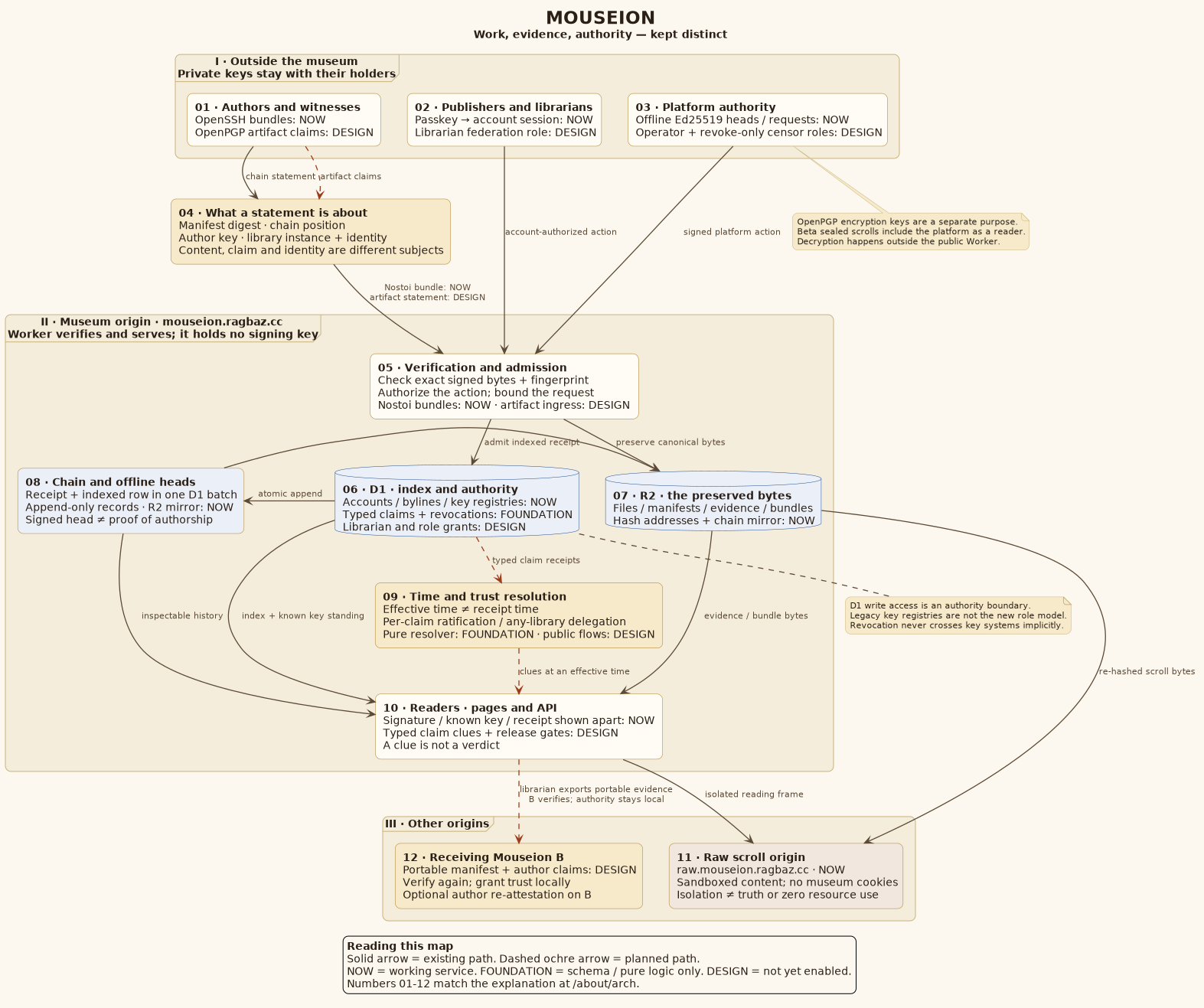
01–03 · A person is not a key, and a key is not a permission
A key lets someone sign or receive something. An account lets someone use the site. Permission tells the site which actions they may take. Possessing one does not silently give them the others.
- 01 · Authors and witnesses
An author can claim “I helped make this”; a witness can say “I believe this credit is correct”. The artifact design lets either use an OpenPGP key without creating an account. A signed label is still the signer's claim about identity. Optional, explicit profile linking comes later; the site does not infer it.
- 02 · Publishers and librarians
Passkeys authenticate an account, and a session authorizes current account operations. A publisher selects the byline for each scroll. The future librarian role receives and federates works. A library is the pair of a Mouseion instance and one librarian identity; portable references use a public identity, never the private account id.
- 03 · Platform authority
Offline Ed25519 keys sign chain heads and current curator requests. The current signed curator action registers a pinned platform key. The new operator and censor roles are planned, not active permissions: an operator will ratify claims or grant librarian trust; a platform-attested censor will revoke attestations only.
Different keys answer different questions
- Passkeys prove control of an account sign-in. They do not prove authorship of an artifact.
- Publisher OpenPGP mother and correspondence keys belong to one chosen byline. Their public material may be registered; the private half stays with its holder. Public user IDs can reveal a name, so registration asks for acknowledgement.
- Platform OpenPGP keys have two config-pinned purposes: reading sealed scrolls and receiving correspondence. During the public beta, sealed scrolls include the platform as a reader. The platform correspondence key is in every scroll's correspondence set.
- Nostoi bundle keys use OpenSSH Ed25519 signatures, with their own fingerprints and the separate D1 registry
attestation_signers. The Worker verifies them; a signing key need not already be known here. - Chain-head and curator keys use raw Ed25519 keys and the separate registry
trusted_signers. A signed head commits to a particular chain position. A signed action must also satisfy its action and freshness checks.
Consequence: trust or revocation in one registry does not transfer to another. An OpenPGP correspondence key is not an OpenSSH bundle key, even if the same person holds both. Librarian attester trust will not grant login, publish-as-author or decryption rights.
04 · First ask: what, exactly, is being claimed?
Two statements can mention the same work and still say different things. A useful record identifies both its subject and the assertion made about it.
- The artifact manifest
A manifest inventories the work's files and their hashes. Its full SHA-256 identifies a particular set of bytes and metadata, including credits when the versioned manifest supports them. It may be signed before publication and before any Mouseion assigns a scroll id. A changed manifest is a different subject.
- A local scroll
A namespaced scroll id locates a publication in one museum. Its decorative slug can vary without changing which scroll it addresses. A local id is not a substitute for the full manifest digest in a portable artifact claim.
- A chain position
An existing Nostoi bundle names a chain, format, sequence number and head digest. It says what its signer asserts about that position. It does not, by itself, verify all of the referenced chain or establish authorship of a nearby scroll.
- An author key or library
A standing delegation names the author key whose works it covers. A librarian-trust grant names an instance-and-librarian pair, not every account at that instance and not every instance where the person appears.
- One claim
Ratification and revocation name a specific statement by its immutable identity. Endorsing one witness claim does not endorse all claims about the work.
There are also two credit surfaces: the manifest and the work's actual content. A name in a manifest and an alias in the text may correspond, but the system must not decide that merely because they look similar. The typed design gives a witness a separate witness.credit_match claim to express that belief, naming both surfaces.
05 · Check the statement before giving it a place
Receiving a file is not the same as accepting its evidence. Mouseion first checks what it can check, then admits only the kind of action the sender is allowed to request.
The current Nostoi bundle endpoint checks the document's shape, format, signing namespace, canonical bytes, Ed25519 signature and pinned fingerprint. Invalid bundles are refused rather than displayed as unchecked evidence. A valid unknown key is accepted as an unknown key; its signature is the credential for this submission, not proof of a person's name. Browser submissions must also satisfy the site's origin rule, and bundles have a size limit.
The artifact-claim ingress is a next step. It will sign and verify the canonical whole statement: version, kind, subject, credit or permission payload, signing identity and effective dates. Signing a bare file hash would not authenticate an accompanying license, delegation or release date. Verification and authorization remain separate: a valid signature on an operator request is insufficient without the appropriate current role.
Consequence: a verified signature establishes the signing key and signed bytes. It does not establish that the assertion is true, that the signer owns the rights they claim, or that every requested action is permitted.
Supporting evidence is broader than a verified bundle. A model-provenance report, an attached OpenPGP signature or a ledger excerpt can be useful material without its every assertion having been independently checked. Keeping an evidence file and verifying a particular signed contract are different services; a page should say which it has done.
06–08 · Keep the bytes and the receipt together
The museum needs both the thing it received and a record of receiving it. A file without a receipt has little history; a receipt without its file is hard to examine.
06 · D1 holds the index, private account associations, bylines, public key registries and the chain records. It also contains the new append-only claim and revocation tables. Their schema exists, but there is no public artifact-claim write API yet. New librarian bindings and role grants will live here, so registering or trusting a librarian will not require redeploying the Worker. The existing config pins for the two platform encryption identities remain a different mechanism.
07 · R2 holds scroll files, manifests, evidence, received bundles and the chain mirror. Content-addressed objects are identified by hashes. Their bytes are checked again when read: a mismatch is reported rather than served as the recorded object. Existing Nostoi bundles are stored in canonical form, retaining the statement the signature covers.
08 · The chain links each new record to the preceding digest. A scroll/evidence mutation or bundle receipt and its indexed row are committed in the same D1 batch. Database triggers reject edits to the chain; the Worker computes the compatible Nostoi digests. Heads are signed offline, and the mirror lets others examine the record.
There is an important limit. A chain is evidence of consistency with the copy or signed head a reader checks; it cannot make its operator incapable of replacing a database and presenting a new history. Retained copies, independently held signatures and future external witnesses strengthen that comparison. Likewise, direct D1 administration is an authority boundary: legacy SQL-managed key registries are not already a complete, signed history of the new trust roles.
Consequence: the public Worker holds no signing private key. Platform decryption belongs outside it. Control of storage and of offline signing keys remains operational power; the architecture makes that power inspectable rather than pretending it disappears.
09 · Trust is a dated statement, not a permanent stamp
Someone can make a claim, another person can support it, and a permission can later be withdrawn. Those are separate events. Keeping them separate preserves both the evidence and the reader's ability to judge it.
The typed artifact schema and pure resolver exist as a foundation. They are not yet wired into public submission, role authorization or the colophon. The model distinguishes:
- Self-authorship: the signing author claims a specified credit.
- Witness authorship: someone expresses belief that a specified credit names an actual author.
- Credit correspondence: someone expresses belief that a manifest credit matches a name or alias in the content. It is not an automatic identity merge.
- License: an author states a controlled license identifier, with optional explanation. A signature does not manufacture copyright or settle a rights dispute.
- Delegation: an author grants any library permission to federate one manifest, or makes a standing grant tied to the same author key. Other delegation types can come later.
- Librarian authorship: the receiving librarian records their own authorship assertion.
- Operator ratification: the operator supports one identified claim, not the entire artifact.
- Librarian trust: the operator gives a particular library standing attester trust. This is not an author delegation or a license.
A new revocation withdraws a target claim's effects from an effective instant while retaining the original statement and its receipt. The planned censor role can make these revocations only; it cannot edit the work, change its byline, grant a role or erase its history.
The resolver asks two time questions. Effective time asks which effects apply at an instant. Receipt time asks which statements the museum had received by an instant. A compromise reported tomorrow may withdraw trust from last week without pretending readers knew about it last week. Effective intervals include their start and exclude their end.
Consequence: revoking librarian trust removes that grant's effects, not the librarian's existing signatures. Revoking a ratification does not revoke the underlying author claim. A new grant can restore trust prospectively without rewriting the revoked one. A public, time-effective revocation feed is planned; today's legacy signer status is not that feed.
10–12 · Crossing a boundary does not carry every permission with it
A work may be displayed, run as code, or copied to another museum. Each move changes the setting in which it is encountered, so each has its own rules.
10 · Reader views currently separate signature verification, the museum's knowledge of a bundle key, and the receipt recorded in its chain. The richer typed-claim colophon is planned. A future publication date will be a visibility rule, not a signature-validity test: a receiving platform may honor it after federation. Full release enforcement across listings, pages, raw files, previews, APIs and bundles is still to be built. The pure date helper is not an active embargo service.
11 · The raw origin serves scroll content separately from the museum interface, without museum cookies and inside a browser sandbox. Untrusted content cannot inherit the museum's account session. That isolation does not make the content accurate or harmless in every respect: a script can still consume computing resources, and an intentionally followed link can take a reader elsewhere.
12 · Receiving Mouseion B is the federation design. A librarian presents the exact manifest and independently signed author claims. B verifies them again, records its own receipt, and decides what local trust or ratification to grant. Source A's endorsement does not automatically become B's authority. An author may also re-attest directly on B; an account remains optional for author signatures.
Consequence: portable evidence can travel while platform authority stays local. A federation grant is permission to carry the specified work under its terms, not permission to impersonate its author. A release date travels as an authenticated statement when signed, but a receiving platform's visibility policy determines whether it honors that date.
Questions and answers
The most useful test of an architecture is whether its distinctions survive an ordinary question. These answers make the boundaries concrete.
Does “signature verified” mean “this person wrote it”?
No. It means the named key signed the checked bytes. Connecting that key to a person, establishing authorship and judging the work are further questions. A signed author label is an assertion, not a verified identity.
Does a hash prove that a work is true or original?
No. It identifies and compares bytes. A faithful copy can preserve a mistake, a fabrication or an unattributed passage just as faithfully as a sound argument.
Is every attached piece of evidence independently verified?
No. Keeping an evidence file by its hash establishes which file was received. A model name or an authorship assertion in that file may still be reported rather than proved. The current Nostoi bundle endpoint does verify its specific signature contract; that guarantee must not be borrowed for an arbitrary attachment.
Do I need an account to bring a signed statement?
Current valid Nostoi bundles need no session; the signature is their submission credential. Accountless OpenPGP artifact claims are part of the design, but that public ingress is not yet implemented. Account operations still require account authentication.
Can I sign an unpublished work?
Yes, in the artifact design: the subject is a full manifest digest, not a live URL. This does not make the work public. Scheduled public release and its route-wide enforcement are subsequent features.
What is the difference between a witness and an author?
An author claims participation in making the work. A witness expresses belief about a credit. A credit-match witness relates the manifest to names appearing in the content. None automatically edits a byline or connects a person's private identities.
If any library is delegated, can any account publish as me?
No. The grant covers federation of the specified work, or the standing author-key scope. It is not a login credential. License, delegation, librarian role and local admission policy remain separate.
If a librarian is trusted, are all their claims true?
No. Standing attester trust records the operator's confidence in that instance-and-librarian pair. It is a clue about the source; per-claim ratification names a particular assertion. Neither turns a belief into proof.
What happens when trust is revoked?
In the typed model, the recorded grant stops having effects at its cutoff. Original claims, verified signatures and receipts remain inspectable. The receipt time shows when the museum learned of the withdrawal; the effective time shows when it applies.
Can a censor remove a scroll or create a new operator?
No. The agreed role is revoke-attestations-only. It is not yet an active endpoint, and the future permission must be checked for each action. Content administration is a separate power.
Can the platform read a sealed scroll?
During the public beta, yes. Sealed scrolls must include the pinned platform scroll key among their recipients. The public Worker stores ciphertext; decryption happens elsewhere. Encryption here must not be mistaken for secrecy from the platform.
Can someone change history without being noticed?
The normal database interface cannot edit the chain. A privileged operator could replace storage, however. Comparing against a retained chain copy or independently held signed head can expose a conflicting history. Future independent witnessing strengthens that protection; a chain alone is not an absolute guarantee.
Does federation transfer a museum's trust to another museum?
No. It transfers bytes and checkable statements. The receiving museum verifies them and decides its own local authority. It may honor a publication date, but the current system does not yet offer that federation-and-release workflow.
Where can I inspect what works today?
Read a scroll's colophon, visit the Nostoi bundle collection, inspect the chain, and consult the roadmap. The implementation and its committed federation plan are in the source repository. Questions about a particular work or policy belong in a letter to the curator.